Spice ware with cut-out lid

Spice ware with cut-out lid
This utensil with a cut-out lid was displayed by the Marvolpolska Museum. The cutouts have unique cutouts for placing spices or fragrance combinations. It is an exquisite vessel made of porcelain and metal, showing superb craftsmanship and design beauty. This kind of utensil is not only practical, but also a combination of art and craftsmanship, reflecting the fashion and taste of the time.
Geometric pattern ceramic plate

Geometric pattern ceramic plate

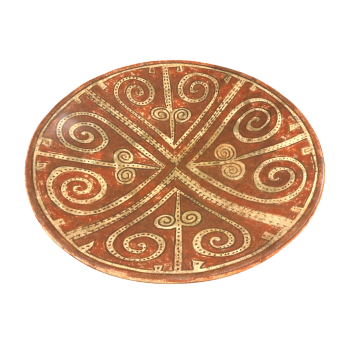
It is a ceramic plate with a circular base and geometric pattern, belonging to the Conte style, made approximately between 700 and 1000 years ago, from the Gran Cocl é region. This ceramic plate is known for its unique Conte style colors (red, black on cream base, and red circular base). There is usually a typical humanoid pattern in the center of the plate, which appears in multiple plates of the same style, suggesting that it may represent some mythical image. This work not only serves as a practical dining utensil, but also reflects the aesthetic taste and cultural symbol of the society at that time.
Medieval ceramic bowl

Medieval ceramic bowl

It is a pottery bowl from the medieval period, dating back to approximately between the 14th and 15th centuries. This cultural relic was discovered decades ago in a building near the current History Museum. It effectively showcases the appearance of daily necessities in the Girona region during the medieval period. This pottery bowl was modeled by the Pol Guiu and La Tempesta teams, with text provided by MHG and registration number MHG 8314-158. The detailed information of this model can be found on the official website of the Girona Historical Museum.
Tübingen University Museum Attica red pottery bottle

Tübingen University Museum Attica red pottery bottle

A ceramic vessel from the ancient Greek period characterized by a black glaze on red clay pottery, with figures and figures in the outline of the pattern retaining the original red color of the clay, creating a sharp contrast. This style, which appeared around 530 BC and reached its peak in the 5th century BC, is representative of pottery making in the Attica region of ancient Greece. The red colored pottery bottle is usually used to mix water and wine. Its shape is wide mouth, short neck, deep abdomen, handles on both sides, and wide and stable circle feet at the bottom. Not only had a practical function in ancient Greek society, the patterns on the surface also reflected the cultural and artistic level of ancient Greece.
Ancient Greek clay pot

Ancient Greek clay pot

The ancient Greek clay pot was an ancient Greek ceramic vessel, often used to store and transport small quantities of liquids, such as oils and perfumes. The artifact you mentioned was found on the island of Cyprus during the European Iron Age in the 7th century BC. Production period 7th century BC, Europe (period) Iron Age. It is found on the island of Cyprus (origin). Dimensions: height 22cm, diameter 12.3cm, currently collected in the Louvre Museum in France.
Porcelain bowl with copper edge inlaid with blue and white porcelain from the Qianlong period of the Qing Dynasty

Porcelain bowl with copper edge inlaid with blue and white porcelain from the Qianlong period of the Qing Dynasty

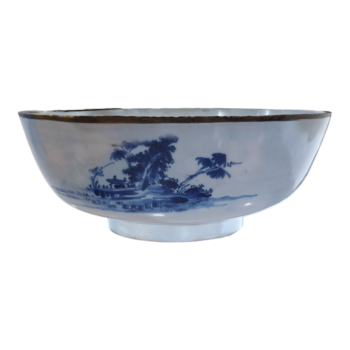
The blue and white porcelain bowls made during the Qianlong period of the Qing Dynasty are now preserved in the Hunt Museum in England. The outer edge of the bowl is decorated with a Pegasus frame,
17th century Polish porcelain "Pear shaped Flower Coffee Pot"

17th century Polish porcelain "Pear shaped Flower Coffee Pot"

This porcelain pot is collected in the Royal Museum of Vail. The handle of the pot is shaped like the letter "J", with volutes on the top and bottom, and raised leaves and palms on the outside. The pot has a dome cap with a collar. The painting style includes randomly arranged flowers and realistic insects, with shadows painted in gray. This type of decoration became popular in the 1730s and was the first typical European porcelain painting style. The designs of flowers, fruits, and insects are taken from plant patterns.
Porcelain from the Wanli period of the Ming Dynasty, titled 'Silver Gold Plated Inlaid Blue and White Porcelain Bowl'

Porcelain from the Wanli period of the Ming Dynasty, titled 'Silver Gold Plated Inlaid Blue and White Porcelain Bowl'

The blue and white porcelain bowl made during the Wanli period of the Ming Dynasty (1573-1619) is currently preserved in the Hunt Museum in England. The outer edge of the bowl is decorated with a Pegasus frame, and the bowl wall is decorated with flower spray.
Porcelain from the Kangxi period of the Qing Dynasty: "Porcelain Salt Bottles from the Kangxi Period of the Qing Dynasty"

Porcelain from the Kangxi period of the Qing Dynasty: "Porcelain Salt Bottles from the Kangxi Period of the Qing Dynasty"

This Chinese cultural relic is a porcelain called "Porcelain Salt Bottle from the Kangxi Period of the Qing Dynasty". It was fired during the Kangxi period of China (1662-1722) and is currently housed in the Krakow Salt Mine Museum in Poland. Before the development of porcelain production technology in Europe, porcelain from foreign countries had already been imported since the Middle Ages, and their prices often exceeded those of similar silverware. For many years, they have only been used for decoration, while their fashion trends continue to spread. These products have aroused the curiosity of European buyers due to their rich and exotic patterns.
Porcelain from the Kangxi period of the Qing Dynasty: Painted pottery bowls during the Kangxi period

Porcelain from the Kangxi period of the Qing Dynasty: Painted pottery bowls during the Kangxi period

The ceramic bottle "Pelik" from the classical period of ancient Greece

The ceramic bottle "Pelik" from the classical period of ancient Greece

Pelik is a Greek container made of ceramic double ear bottles used for storing liquids. The cultural relic collected by the Krakow National Museum is made in the Kerch style, which is characterized by items produced in Athens in the 4th century BC and exported to cities in the northern Black Sea. The popular decorative theme of the Kerch style vessels comes from the cycle of Dionysius: on the belly of Pelik, depicting Dionysius' attendants. From the left dance pose, Dionysius' half man, half beast, Menard playing drums, and another half man, half beast. Menard tilted slightly backwards, attracting the attention of other participants amidst religious fervor.
Vessel in the Form of a Fish from the Middle Nazca Period

Vessel in the Form of a Fish from the Middle Nazca Period

Fish-shaped vessels were made from about 100 BC to 600 AD and are part of the Nazca culture. NASCAR artists are known for their bold, colorful designs. They are keen observers of the world around them and depict many plants and animals in their work, but they seem more concerned with capturing the spirit and vividness of the subject than naturalism. The image of this fish is highly abstract, the scales are suggested by strokes, and the gills are represented by streamlined lines. It is round and fat, proving a rich food supply. Fish is a key component of the Nazca diet and often appears in their art.